
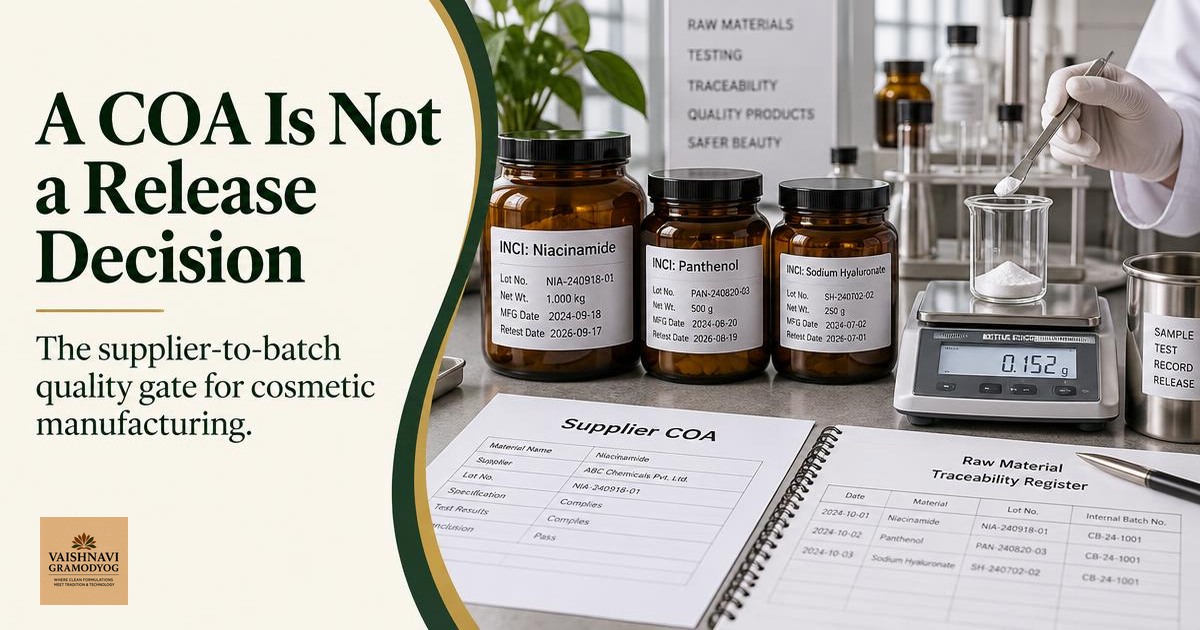
A supplier COA is only one input. Learn how cosmetic manufacturers qualify vendors, assess incoming lots and document QC release.
A Cosmetic Raw Material COA Is Not a Release Decision: Build the Supplier-to-Batch Quality Gate
A supplier sends a Certificate of Analysis (COA). The material name, lot number, specification and results appear correct; purchasing files the document, stores receive the drums and production requests the material.
That process can still contain a blind spot.
A supplier COA is evidence about a lot tested by the supplier. It does not, by itself, prove that the delivered container is the same lot, that the material remained in suitable condition during transport and storage, or that it is suitable for the formulation in which it will be used.
For a cosmetic manufacturer, the key question is not simply, “Did we receive a COA?” It is, “What evidence allowed Quality Control to release this delivered lot for this product?”
What a COA can—and cannot—establish
A well-prepared COA identifies the material and supplier lot, lists test parameters, states limits, reports results and identifies methods. It belongs in the incoming-material file, but it has boundaries.
A COA does not automatically establish that:
- the container received carries the same lot number as the document;
- the supplier's sample represents every container in the shipment;
- the material has not been exposed to heat, moisture, light or contamination after testing;
- the supplier's grade and specification suit your intended application;
- the test methods and limits match your approved raw-material specification;
- a change in manufacturer, site or process has been assessed;
- the material will perform identically in your formulation.
The aim is not to distrust every supplier. It is to distinguish supplier evidence from receipt checks and the manufacturer's own QC release decision.
India's regulatory framework
For products regulated as cosmetics under the Cosmetics Rules, 2020, Rule 26(h) requires the licensee to test each batch or lot of raw materials used in manufacturing cosmetics and each batch of the finished product, maintain records of those tests, and retain the test records for three years from the date of manufacture. Rule 26(f) separately addresses batch and raw-material-use records under the Eighth Schedule, with retention for three years after the batch expiry date.
The Seventh Schedule describes QC activities including sampling, inspection and testing of raw and packaging materials, in-process materials, intermediates, bulk products and finished products. It also describes a parametric-release route for raw materials where vendors are approved and procedures are robust, validated and based on trends from earlier testing. Under the defined SOP, every batch need not necessarily undergo the same testing, but QC must still approve and release it.
This is not a blanket permission to accept a COA without review. Parametric release is a controlled route with conditions—not an informal shortcut. Document vendor approval, validation, trend evidence, the release procedure and the QC decision; confirm applicability with qualified regulatory support or the relevant State Licensing Authority. Ayurvedic drugs manufactured under a separate ASU drug licence may have a different framework, so product classification matters.
ISO 22716:2007 is the published international guideline for cosmetic GMP and was reviewed and confirmed by ISO in 2022. It provides a framework for production, control, storage and shipment, alongside applicable Indian rules and product-specific specifications.
Six gates between supplier dispatch and production use
The depth of control should be risk-based. A botanical extract, preservative, fragrance, colourant, polymer and bulk surfactant do not necessarily need identical tests.
1. Qualify the supplier and the grade
Approve more than a trading name. Record the legal supplier, actual manufacturer and site where relevant, grade, specification, COA format, Safety Data Sheet, storage conditions and change-notification route. For critical materials, review quality history, complaint response and lot traceability.
An approved supplier list should identify the approved material and grade—not merely the vendor.
2. Review the COA against the approved specification
Check material identity, INCI or chemical name, grade, manufacturer, lot number, manufacturing or retest date, parameters, limits, results, units and methods. Confirm that the document matches the exact lot received and the current specification.
A generic “complies” statement may be inadequate where a numerical result is expected. Retain specification revisions and assess whether changes affect the formula or product specification.
3. Receive, identify and quarantine the lot
Reconcile the purchase order, delivery challan, supplier label, container count, lot number and COA. Inspect seals, container condition, leakage, odour, moisture ingress and visible contamination. Assign an internal receipt number and a clear status—under test, approved or rejected.
Keep unapproved material controlled so it cannot be issued to production accidentally. This simple gate prevents a document-to-container mismatch from becoming a batch deviation.
4. Apply a material-specific test plan
Choose checks according to the material's critical quality attributes and risk. Depending on the ingredient, these may include identity, assay or active matter, pH, moisture, viscosity, density, colour, odour, solubility, microbial quality or impurity limits.
Not every parameter applies to every material. The specification should define the method, acceptance criteria, sampling approach and out-of-specification process. Botanical materials deserve particular attention because source, harvest, extraction, carrier, drying and storage can influence their characteristics.
5. Check formulation performance when a change could matter
A material can meet its incoming specification and still affect the formula. A polymer grade may change viscosity build; a surfactant lot may alter clarity or foam; an extract may shift colour or odour.
For a new supplier, grade or meaningful specification change, consider a controlled bench or pilot comparison with the approved reference. Define the attributes to compare—such as appearance, pH, viscosity, clarity, odour, processability or compatibility. This supplements, rather than replaces, required incoming tests.
6. Record release and preserve traceability
QC should record the release decision. Link the supplier lot and internal receipt number to the COA, inspection and test results, deviations, approval and the finished-product batches in which the material was used.
For rejected or conditionally accepted lots, record disposition and prevent unintended use. If a complaint or stability shift occurs later, the manufacturer should be able to identify which raw-material lots entered the affected finished-product batches.
What if the supplier or source changes?
A second source can improve supply continuity, but it is not a clerical vendor-master update. A change in manufacturer, site, grade, specification, process, carrier, concentration, packaging or test method may affect performance.
Before approval, record the proposed change, affected products, technical comparison, risk assessment, additional testing or pilot work, required approvals and documents to revise. The technical agreement should define which changes the manufacturer must notify, what evidence is required and when the brand owner must approve before implementation.
“Same INCI” should not become an automatic equivalence decision.
Seven questions to ask a manufacturing partner
Before a new-product or repeat-order PO, ask:
- How are suppliers and specific grades qualified?
- How is the delivered lot reconciled with its COA?
- Which incoming tests are selected for each material, and why?
- How are under-test, approved and rejected materials controlled?
- Can a raw-material lot be traced to finished-product batches?
- How are source, grade or specification changes assessed?
- How are deviations and customer approvals documented?
A manufacturer should be able to explain the process and show a suitably redacted example of the records. Buyers do not need confidential supplier pricing or proprietary formulas to assess whether the control system is real.
A better release decision protects more than the batch
Raw-material quality is where procurement discipline, formulation knowledge and manufacturing control meet. A low purchase price does not compensate for a lot that causes rework, delay or an investigation that cannot be traced.
The objective is not to test everything blindly. It is to define the right specification, qualify the supplier, verify the right evidence, apply proportionate checks and record a clear QC release decision.
At Vaishnavi Gramodyog, we treat incoming raw-material control as the first quality gate in the manufacturing sequence. For brands evaluating an OEM or private-label partner, ask how incoming checks connect to the approved formulation, batch record and finished-product release.
Before your next purchase order, ask to see the raw-material release flow—not just the COA.
Frequently asked questions
Is a supplier COA enough to release a cosmetic raw material?
No. It is one part of the evidence file. The manufacturer must follow applicable regulatory obligations and approved procedures, verify the delivered lot and make a documented QC release decision.
Does every incoming raw-material lot need testing in India?
Rule 26(h) sets out batch/lot testing and record requirements. The Seventh Schedule also describes a controlled parametric-release approach where approved vendors and robust, validated, trend-based procedures are in place. It should not be treated as a general COA-only exemption; confirm the intended approach with qualified regulatory support.
How long should raw-material test records be retained?
Rule 26(h) specifies three years from manufacture for raw-material and finished-product test records. Rule 26(f) separately addresses batch and raw-material-use records, retained for three years after batch expiry.
Is a second supplier with the same INCI automatically equivalent?
No. Compare manufacturer, grade, specification, source, process and critical quality attributes. Assess the change, define additional evidence and obtain the required internal and customer approvals before routine use.
Which materials need the most attention?
It depends on product and risk. Botanical powders and extracts, preservatives, fragrances, colourants, surfactants and performance-critical polymers may need different identity, chemical, physical or microbiological controls.
Related resources
- Botanical extract standardization for batch consistency
- Cosmetic formula scale-up: what a pilot batch should prove
- Cosmetic stability testing protocols
- Vaishnavi Gramodyog quality and compliance
- Our manufacturing process
Regulatory and standards references
Brief us on your next SKU
Share the product, volume and launch window. We'll respond with a manufacturing plan and documentation scope for your target market.
Request bulk quote