
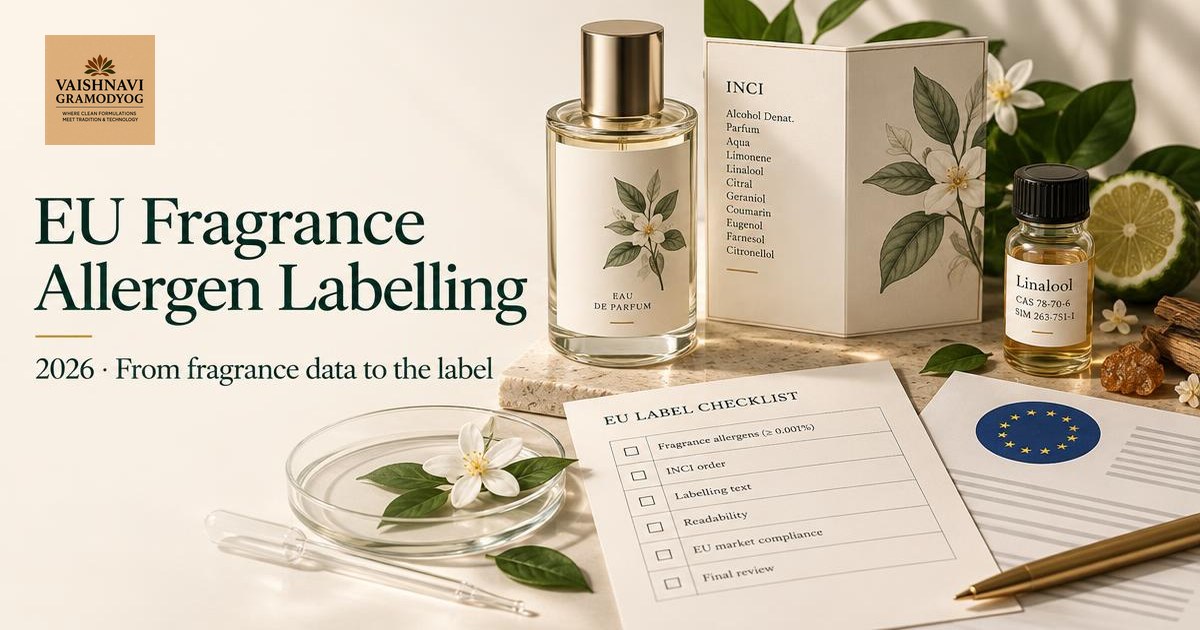
The EU fragrance-allergen labelling transition is now in force for newly placed cosmetic products. Indian exporters should connect supplier data, finished-product calculations and approved INCI artwork.
The EU fragrance-label transition has passed its first deadline
For Indian cosmetic brands supplying the European Union, fragrance documentation is no longer only a perfumery or formulation file. It is part of the label-release process.
Commission Regulation (EU) 2023/1545 amended Annex III of the EU Cosmetics Regulation, Regulation (EC) No 1223/2009. It introduces individual labelling requirements for 56 additional fragrance allergens, updates several existing entries and expands the set of substances that must be named separately when they exceed the relevant concentration threshold in the finished cosmetic product. The European Commission confirms that the thresholds are above 0.001% for leave-on products and above 0.01% for rinse-off products. Read the Commission's current guidance.
The first deadline was 31 July 2026: non-compliant products may no longer be newly placed on the EU market. Qualifying products placed before that date may continue to be made available until 31 July 2028.
What changed under Regulation (EU) 2023/1545?
Previously, 24 fragrance allergens were individually labelled under the EU Cosmetics Regulation. The amendment adds 56 more, while also revising and grouping some existing entries. The European Commission describes the expanded disclosure requirement as applying to more than 80 fragrance allergens in total.
The purpose is consumer information: sensitised consumers can identify substances they may need to avoid. An allergen appearing on the ingredient list does not, by itself, mean the product is unsafe or prohibited.
The rules cover fragranced creams, shampoos, deodorants, body washes, soaps and other cosmetic formats—not only perfumes.
Understand the two finished-product thresholds
The individual labelling trigger is based on the concentration of the listed allergen in the finished cosmetic product, not simply the percentage of fragrance compound added to the batch.
- Leave-on products: above 0.001% in the finished cosmetic.
- Rinse-off products: above 0.01% in the finished cosmetic.
For example, imagine a leave-on lotion contains 0.5% of a fragrance compound, and the supplier's allergen declaration states that a particular listed allergen makes up 0.3% of that fragrance compound. The illustrative finished-product concentration would be 0.0015% (0.5% × 0.3%). That is above the leave-on disclosure threshold. The same calculated concentration would be below the 0.01% rinse-off threshold, although the complete formula and all applicable restrictions still need review.
The label decision needs supplier data that supports each listed allergen calculation in the finished product.
The transition dates: placing versus making available
The two dates are not interchangeable:
- 31 July 2026 — placing on the market: from this point, a cosmetic product newly placed on the EU market must comply with the expanded fragrance-allergen labelling requirements.
- 31 July 2028 — making available: qualifying products placed on the market before 31 July 2026 may continue to be supplied during the sell-through period, subject to the regulation's conditions.
The Irish Health Products Regulatory Authority (HPRA) provides a useful operational explanation. It states that “placing on the market” means the first making available of a product on the EU market, while “making available” covers subsequent commercial supply. It also clarifies that a CPNP notification alone does not prove that a product has been placed on the market. Evidence that the product was actually available for sale—such as invoices or batch-specific certificates of analysis—may be requested during market surveillance. See the HPRA industry guidance.
For exporters, retain records of actual market availability; a notification, manufacturing date or purchase order alone is not proof of first placement.
Why white-label and relabelled products need special attention
The HPRA specifically warns that rebranding, repackaging, reformulation or relabelling may be considered the placing of a new product on the market. Products newly placed after 31 July 2026 are expected to meet the expanded labelling requirements.
This is particularly relevant to Indian contract manufacturing. A base formula may have existed before the deadline, but a new brand presentation, new pack, new formulation or relabelled SKU can require a fresh assessment. A buyer should not assume that an old label or an earlier market placement automatically covers a new private-label launch.
The practical rule is simple: assess the exact product configuration being placed on the EU market—formula, fragrance, pack, label and Responsible Person—not just the underlying bulk formula.
Build a fragrance-data handover that can support artwork approval
The fastest way to create a late-stage label problem is to receive a fragrance compound's commercial name without a usable allergen declaration. Before locking the formula or print-ready artwork, request a current document from the fragrance supplier that identifies the relevant Annex III allergens and their concentrations or otherwise provides sufficient data for the finished-product calculation.
A controlled handover should connect the fragrance supplier and code, document revision, allergen concentration data, approved use level, leave-on/rinse-off classification, finished-product calculation, INCI artwork revision and EU Responsible Person approval.
Keep the fragrance supplier's allergen declaration separate from an IFRA Certificate of Conformity. IFRA documentation addresses conformity with applicable IFRA Standards for the intended use; it should not be treated as a substitute for the EU Annex III allergen calculation and label review.
Natural fragrance materials are not automatically exempt
Essential oils, botanical aromatic extracts and naturally derived fragrance ingredients can contain substances listed as fragrance allergens. “Natural”, “Ayurvedic-inspired” or “plant-based” is not a reason to skip the review.
Request data for the actual material grade and revision. A supplier change, fragrance reformulation or revised use level should trigger a fresh calculation and artwork review.
A practical EU export review for each SKU
Before the next EU-bound order, create a simple SKU-level check:
- Confirm the destination is the EU and identify the EU Responsible Person.
- Confirm the product's leave-on or rinse-off classification.
- Match the approved formula to the exact fragrance code and supplier revision.
- Obtain the current allergen declaration for that fragrance material.
- Calculate each listed allergen's concentration in the finished product.
- Compare the result with the applicable threshold and other Annex III restrictions.
- Update the ingredient list and pack artwork where required.
- Reconcile the label, formula, product information file and safety assessment.
- Record the approval and retain evidence for the exact SKU and artwork version.
- Reopen the review after any fragrance, formula, supplier, pack or market change.
For legacy stock, retain evidence supporting the date on which the product was first made available on the EU market. For a new or relabelled private-label SKU, do not rely on the legacy-stock transition without confirming that the specific product qualifies.
What this means for Indian contract manufacturers and brand owners
An Indian manufacturer may supply formulation details, fragrance data, INCI support, batch records and artwork coordination. The EU Responsible Person remains central to ensuring that the product information file, safety assessment and market-facing label are aligned with the EU Cosmetics Regulation. Responsibilities should be agreed in the technical agreement and product-development brief rather than left until the export documents are being prepared.
For contract manufacturing, maintain one revision trail linking fragrance code, formula use level, calculated allergen list, artwork version and market-release decision.
Explore our related fragrance brief guide for personal-care products, export compliance support, third-party manufacturing capabilities and documented manufacturing process.
FAQs
Does "parfum" alone satisfy the new EU fragrance-allergen labelling rules?
Not where a listed Annex III fragrance allergen is present above the applicable finished-product threshold. The relevant allergen must be individually identified in the ingredient list, in addition to the applicable fragrance-composition declaration.
Do the thresholds apply to the fragrance compound or the finished cosmetic?
They apply to the concentration of each listed allergen in the finished cosmetic product. The fragrance compound's allergen data must be combined with the actual fragrance-use level in the formula.
Can products already in the EU continue to be sold until 31 July 2028?
Products placed on the EU market before 31 July 2026 may continue to be made available until 31 July 2028 under the regulation's transition conditions. The business should retain evidence supporting the first market placement.
Does CPNP notification prove that a product was placed on the EU market before the deadline?
No. HPRA guidance states that notification alone is not sufficient; the product must have been actually available for sale. Invoices or batch-specific records may be requested as evidence.
Does a new private-label or relabelled version qualify for the old-stock transition?
Do not assume so. HPRA guidance says rebranding, repackaging, reformulation or relabelling may be considered a new product placement. The specific case should be assessed with the EU Responsible Person.
Does an IFRA certificate replace the allergen declaration?
No. IFRA conformity and EU Annex III allergen labelling are separate checks. Obtain the fragrance supplier's allergen data and complete the finished-product calculation for the EU label.
Prepare the next EU label before the print order
Vaishnavi Gramodyog supports Ayurvedic and personal-care contract manufacturing for brands and export partners. For EU-bound projects, align the fragrance code, supplier allergen declaration, approved formula and artwork before production and dispatch planning.
CTA: Before approving your next EU-bound artwork, send the fragrance code, finished-product type and supplier allergen declaration for a label-data gap review.
Official references
- European Commission — Fragrance allergens labelling.
- European Union — Commission Regulation (EU) 2023/1545.
- Health Products Regulatory Authority, Ireland — Labelling of cosmetic fragrance allergens.
This article is an operational overview, not legal advice. The EU Responsible Person and qualified regulatory assessor should confirm the applicable Annex III entries, product classification, finished-product calculations and transitional status for each SKU.
Brief us on your next SKU
Share the product, volume and launch window. We'll respond with a manufacturing plan and documentation scope for your target market.
Request bulk quote