
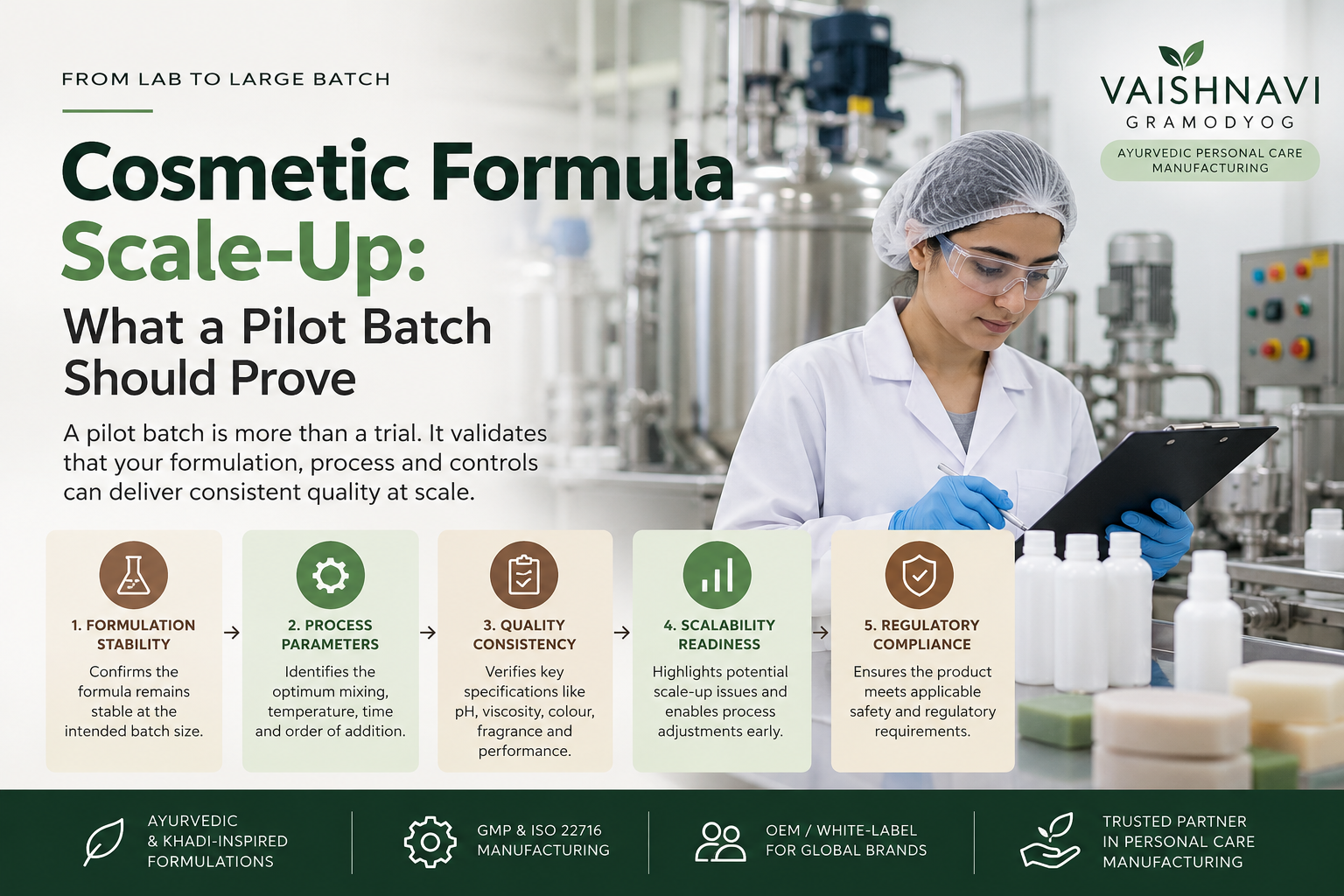
How to transfer a cosmetic formula from lab to pilot by controlling mixing, heat transfer, ingredient sequence, aeration and process checks.
Cosmetic Formula Scale-Up: What a Pilot Batch Should Prove
A laboratory sample can look excellent, feel right and pass review—yet behave differently in a production vessel. That gap can put launch schedules, material budgets and buyer confidence under pressure.
Scaling a cosmetic formula is not simply multiplying each ingredient by the same factor. Even when composition stays constant, the process environment changes: vessel geometry, mixer design, circulation, heating and cooling rates, addition timing, air incorporation and transfer conditions can all influence the finished bulk.
The practical question is not only “Is the formula approved?” It is “Has the process been shown to reproduce the approved product at the next manufacturing scale?”
Technical literature identifies mixing energy, circulation, thermal profiles and the sequence and rate of ingredient addition as important scale-up variables. See Cosmetics & Toiletries: Troubleshooting Lab Bench to Production and Manufacturing Topical Formulations: Scale-up from Lab to Pilot Production.
Why a successful sample is only the first milestone
A lab sample shows that a formula can deliver the intended sensory and technical profile under the conditions used to make it. It does not prove that the same result will follow in a different vessel, with a different impeller, batch depth, heating jacket or cooling system.
A cream may develop the target viscosity in a beaker but become thinner after a longer production cool-down. A shampoo may aerate during mixing and create filling variation. A gel may form lumps because a polymer hydrates differently in a larger water phase. An emulsion may separate if shear and cooling differ from the laboratory process.
These may be process-transfer problems—or evidence that the formula needs further development to become robust enough for manufacturing.
1. Define the attributes that must not drift
Before planning a pilot, identify the critical quality attributes for the specific product. A transparent soap, shampoo, lotion and face wash should not be assessed with an identical checklist.
Depending on the formulation, attributes may include:
- Appearance, colour and odour against an approved reference.
- pH and viscosity measured by a defined method at a specified temperature.
- Homogeneity, dispersion or emulsion appearance.
- Density, air content or filling behaviour where relevant.
- Product-specific sensory performance such as spread, slip, foam or after-feel.
- Microbiological quality and other applicable safety or quality criteria.
- Compatibility with the intended packaging and dispensing system.
Set acceptance ranges before the trial. A visual reference is useful, but it should complement measurable specifications. Define what must remain consistent and which process parameters can be adjusted within an approved range.
2. Translate the mixing process—not just the RPM
Copying the laboratory mixer speed into a production instruction is rarely a complete scale-up strategy. The same RPM on different equipment does not necessarily create the same circulation or shear. Impeller diameter, vessel shape, fill level and viscosity affect how energy moves through the batch.
Too little mixing can leave powders poorly dispersed. Excessive shear can introduce air, raise product temperature or affect shear-sensitive structures. In viscous products, the bulk may not circulate uniformly through the high-shear zone even when the displayed speed looks adequate.
For the pilot, document the equipment and mixing stages: which mixer is used, when high shear is required, when sweep or propeller mixing is appropriate, how long each stage runs and what endpoint indicates readiness for the next step. Pair time-based instructions with practical observations or measurable checks wherever possible.
3. Treat heating and cooling as part of the process history
Temperature is not a single number on a batch sheet. Time to reach temperature, hold duration, phase-combination conditions and cooling rate can all affect product structure.
A small laboratory batch may heat and cool quickly. A larger vessel responds more slowly, and temperature differences can occur across the bulk. Longer heat exposure can affect sensitive ingredients, fragrance retention or water loss. Cooling can influence wax crystallisation, emulsion structure, polymer behaviour and final viscosity.
During the pilot, record actual temperature profiles and important hold times. Note when ingredients are added and at what temperature. If the product thickens during cooling, confirm that mixing remains effective without introducing excess air or damaging the texture.
Reaching the same final temperature does not guarantee the same product; the route taken to get there can matter.
4. Control addition order and hydration
Small-scale work lets a formulator make rapid adjustments while watching the batch. Production introduces longer transfer times, larger additions and more opportunity for an ingredient to encounter the wrong local conditions.
Powders may need pre-wetting or pre-dispersion. Some thickeners hydrate more reliably when dispersed in a suitable carrier before entering the main vessel. Electrolytes, pH adjusters and certain actives may need to be added only after earlier ingredients have dissolved or hydrated. Fragrance and heat-sensitive materials may require a defined addition stage.
Write the sequence in operational terms: material identity, quantity, addition rate, mixing condition, temperature window and endpoint. If a pre-mix is essential, confirm that the production site has suitable equipment and capacity to prepare it consistently.
A pilot should test whether the written method is workable with the equipment and operators who will actually manufacture the product. Repeated improvisation is a sign that the instruction is not ready.
5. Check air, transfer and filling behaviour
Air can enter during mixing, recirculation, pumping or transfer. Depending on the formula, it may affect appearance, apparent viscosity, bulk density, fill weights, pump priming or pack presentation.
Record whether the bulk is visibly aerated and whether the transfer method changes its behaviour. Vacuum processing may help reduce entrained air in suitable systems, but the approach depends on the product and equipment.
Observe the path from vessel to filling line. A bulk that looks correct in the tank may behave differently when pumped through a hose or dispensed through a nozzle. Check representative filled packs, not only a sample taken from the top of the vessel.
6. Make the pilot a controlled learning run
A useful pilot is not simply a smaller commercial order. It is a planned test of whether the process can deliver the approved attributes using the intended equipment and operating instructions.
Before the run, agree on:
- The approved formula and version-controlled manufacturing method.
- Equipment, batch size and planned process parameters.
- Critical stages to observe, including addition, mixing, heating, cooling and transfer.
- Sampling points, test methods and acceptance ranges.
- How deviations and adjustments will be recorded.
- Who reviews the results and authorises the next stage.
During the run, record actual values rather than reconstructing them later. If an adjustment is needed, document the reason, change, approval and resulting observations. Do not silently alter the master instruction because one trial required a correction.
Afterwards, compare results with the predefined criteria and approved reference. Decide whether the process can progress, a targeted repeat is needed, or the formula or method requires more development. The decision should be evidence-led.
7. Carry pilot learning into repeat-batch control
A successful pilot does not prove every future batch will automatically match it. The process must be translated into clear manufacturing instructions, in-process checks, finished-product specifications and change controls.
Record which parameters are critical, which may vary within a justified range and which changes require technical review. Relevant changes can include a different vessel, mixer, batch size, raw-material grade, supplier, fragrance level, packaging format or processing sequence.
For repeat orders, retain the approved reference and ensure the batch record identifies the formula version, raw-material lots, actual process conditions, in-process results, yield and deviations. If viscosity drifts across batches, compare process history and incoming materials before assuming a single ingredient is responsible.
Documentation makes the next run more predictable and gives the brand and manufacturer a shared record when something changes.
Working with your contract manufacturer
Bring manufacturing into the discussion while the formula is still being developed. Share the product format, target batch range, packaging, sensory profile and the attributes most important to the brand. Ask the manufacturer to identify process assumptions that should be tested before commercial commitments are made.
Vaishnavi Gramodyog supports B2B development and manufacturing across haircare, face care, body care and glycerine soap. For suitable projects, pilot MOQ starts at 100 units, batches can range from 100–1,000 units, and typical lead time is 15–20 working days after approved samples and artwork. Custom development or testing can require additional time.
For an initial discussion, provide the approved lab formula or product brief, target batch size, pack format and critical attributes. These details help frame a realistic process-transfer review before production is scheduled.
Conclusion
Scale-up is not about making a larger quantity of the same ingredients. It is about reproducing defined product attributes under different manufacturing conditions. Mixing, thermal history, addition sequence, aeration, transfer and filling deserve attention because each can change the result.
A well-designed pilot turns unknowns into documented learning. It gives R&D, operations, quality and the brand owner a shared basis for deciding what is ready, what needs adjustment and what must be controlled on every subsequent batch.
CTA: Share your approved lab formula or product brief, target batch size and critical quality attributes to scope a pilot-transfer discussion with Vaishnavi Gramodyog.
FAQs
Why can a cosmetic formula change during scale-up if percentages stay the same?
The formula enters a different process environment. Vessel geometry, mixing, shear, heating and cooling, addition sequence and air incorporation can alter how ingredients disperse and structure the finished bulk.
Is matching mixer RPM enough?
No. RPM alone does not define the mixing effect. Equipment geometry, impeller design, fill level, viscosity and circulation also matter.
What should a pilot batch prove?
It should provide evidence that the planned method can deliver agreed quality attributes under representative process conditions and reveal adjustments needed before the next stage.
Does every product require the same pilot tests?
No. Checks depend on the formulation and intended use. A cream, shampoo, gel and glycerine soap have different critical attributes, so the sampling and acceptance plan should be product-specific.
What if the pilot needs an adjustment?
Record the deviation, reason, change, approval and outcome. Then decide whether the master process needs a controlled revision or another trial.
Does a successful pilot guarantee future batches will be identical?
No. Repeatability depends on controlling the approved process, incoming materials, equipment, in-process checks, specifications and change management.
Brief us on your next SKU
Share the product, volume and launch window. We'll respond with a manufacturing plan and documentation scope for your target market.
Request bulk quote