
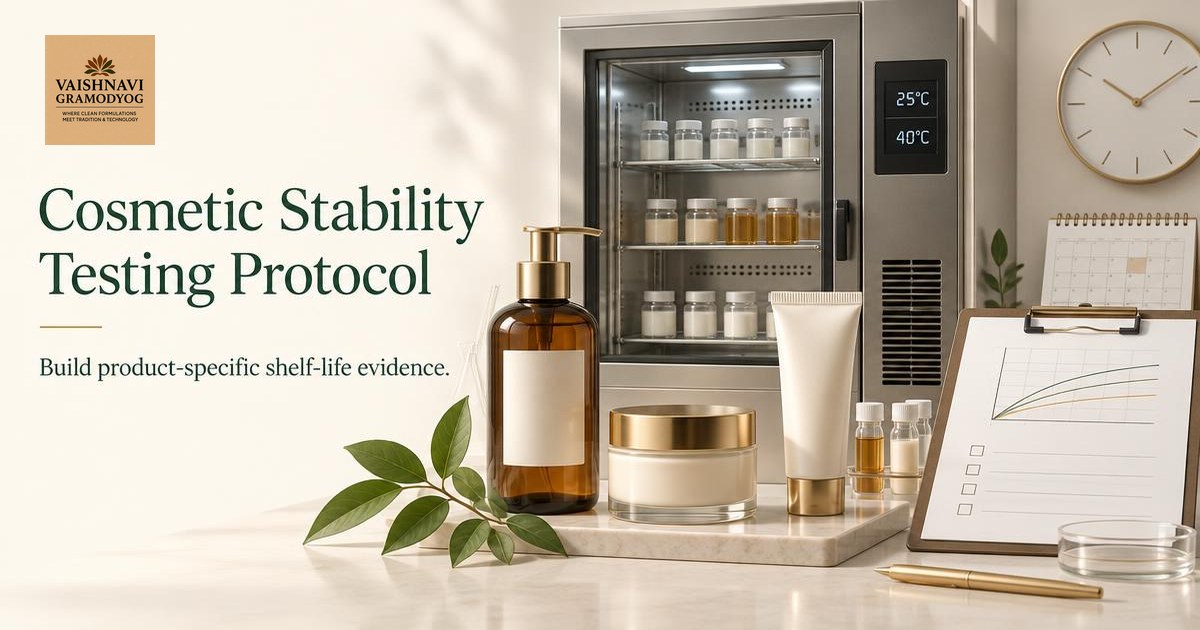
A practical guide to selecting stability conditions, monitoring meaningful product attributes and interpreting accelerated data without overstating shelf-life conclusions.
Why stability testing should be designed, not copied
A product may look unchanged after a few weeks in a warm cabinet and still lack enough evidence for a long shelf-life claim. Conversely, a single stress condition can expose a weakness that is not representative of normal storage. The answer is not to choose a standard number of weeks and treat it as proof; it is to design a protocol around the product, its packaging and the conditions it is expected to experience.
ISO/TR 18811:2018, Cosmetics — Guidelines on the stability testing of cosmetic products, is explicit on this point: it does not prescribe universal test conditions, parameters or acceptance criteria. Because cosmetic products and their storage and use conditions vary widely, the manufacturer is expected to specify and justify the stability protocol. See the official ISO overview.
For a cream, serum, cleanser, hair oil or shampoo, the plan should define what could change, how to detect it and what evidence is needed before release.
1. Start with the product's risk profile
Before choosing a temperature or test duration, describe the product. Is it an oil, aqueous gel, emulsion, suspension, anhydrous balm or surfactant-based cleanser? Does it contain oxidation-sensitive oils, light-sensitive actives, volatile fragrance materials, suspended particles or ingredients that can change colour or odour over time? Is the product transparent, pearlised, opaque or deliberately structured?
The risk profile determines what to monitor: a cream may need phase-separation and viscosity checks; a clear serum may need haze, precipitation, colour and pH checks; a hair oil may need odour, oxidation and pack-interaction checks. Select attributes linked to product quality, user experience, safety and the intended claims—not simply measurements that are easy to record. The same thinking applies across face-care formats such as creams and serums and haircare products such as oils and shampoos.
2. Test the final formula in the intended pack
Stability evidence is strongest when the sample represents the commercial product: approved formula, representative manufacturing process, final container, closure, liner, pump or dropper, label and any protective carton that materially affects storage or light exposure.
Oxygen, light, evaporation, adsorption and container-closure interactions can affect the product or its presentation. A formula in a beaker may behave differently in a clear bottle, airless pump or repeatedly opened jar. Record the exact formula revision and pack; if either changes, document whether the existing data still represents the commercial product.
3. Use accelerated and real-time studies for different purposes
Accelerated stability evaluation uses selected stress conditions to make potential changes easier to detect within a shorter period. Real-time evaluation follows the product under reasonably expected storage conditions over time. These approaches complement one another; they are not interchangeable.
Accelerated results can help identify likely weaknesses, compare formulation options and support a provisional assessment. But the relationship between stress temperature and normal shelf life is not always linear. Some chemical reactions accelerate predictably; other changes may be triggered only at high temperatures or may be reversible. A product that survives one elevated-temperature condition has not automatically demonstrated a specific number of months or years at room temperature.
Real-time data remains important for confirming how the product behaves under the intended storage conditions. The stability programme should define how accelerated observations will be interpreted alongside real-time results, prior product knowledge and any justified formulation-family comparisons.
4. Select conditions that reflect the actual risk
Depending on formula and market, a protocol may consider room-temperature storage, elevated or low temperature, temperature cycling, light exposure or humidity-related packaging risks. Cycling can reveal crystallisation, clouding or emulsion changes; low temperature may expose precipitation or viscosity shifts; light testing may be relevant for sensitive formulas or clear packs. Humidity often tests package-barrier performance unless moisture exchange is a known product risk. Do not apply every stress test to every SKU; document why each condition is included or excluded.
5. Define acceptance criteria before the first reading
A stability report is difficult to interpret if the team decides what counts as failure only after seeing the results. Agree the acceptance criteria at the beginning and connect them to the approved product specification.
Possible attributes include:
- Appearance, colour, odour and texture.
- pH and viscosity, where relevant to the product.
- Phase separation, precipitation, sedimentation or crystal formation.
- Dispensing performance and container-closure condition.
- Weight loss, evaporation or other package-related changes where relevant.
- Microbiological quality and preservative-related evidence, selected according to the product risk and testing plan.
Set appropriate limits rather than assuming every measured value must remain numerically identical. Small variations may be acceptable if they are within a justified specification and do not affect product performance, safety or consumer understanding. Conversely, a subtle change may matter greatly if it signals instability, a preservative concern or a failure of a specific product claim.
6. Keep stability testing separate from other validation questions
Stability testing is not a substitute for preservative efficacy testing, routine microbiological quality checks, transit testing or claim substantiation. Stability follows product attributes over time; microbiological checks assess status at defined points; preservative efficacy tests the preservation system; transit testing evaluates distribution hazards; claim substantiation assesses communicated benefits. These programmes can inform one another, but one result does not prove the others are complete.
7. Make the data traceable and decision-ready
Each observation should identify the product, formula revision, sample/batch, pack, storage condition, time point, method, result and reviewer. Capture photographs under consistent lighting. If a result fails or approaches a limit, document the investigation, reversibility and corrective action; after a meaningful formula or pack change, decide which tests must be repeated. Separate observations from conclusions: “no visible separation at this time point” is not the same as “stable for two years.” Traceable records like these sit within a wider quality and compliance system.
8. A practical protocol-design sequence
Use the following sequence before samples enter a chamber:
- Define product form, intended use, target markets and expected storage conditions.
- Identify likely physical, chemical, microbiological and packaging-related failure modes.
- Select the final formula and representative commercial packaging configuration.
- Choose accelerated and real-time conditions relevant to the identified risks.
- Specify test methods, time points, sample quantities and pre-agreed acceptance criteria.
- Record baseline results before storage begins.
- Review results at defined intervals and document deviations or trends.
- Link the conclusion to the exact formula, process and packaging revision tested.
This framework is not a universal laboratory method; it is a way to make the protocol defensible and product-specific. ISO/TR 18811 provides a technical framework for selecting appropriate methods, but the manufacturer still needs to justify the chosen plan.
FAQs
Is a 12-week accelerated study enough to claim a 24-month shelf life?
Not automatically. The conclusion depends on the product, stress conditions, known degradation pathways, acceptance criteria, supporting real-time data and the rationale used to relate accelerated observations to expected storage. A fixed duration alone does not establish a universal shelf-life conversion.
Does ISO/TR 18811 prescribe one standard temperature for all cosmetics?
No. The ISO technical report explicitly states that it does not specify universal conditions, parameters or acceptance criteria. The manufacturer should select and justify a protocol appropriate to the product.
Should stability samples use the final packaging?
Where feasible, yes. The intended container and closure can influence exposure to light, oxygen, moisture loss and material interaction. If a development-stage pack is used, document why it is representative and assess any differences before applying the results to the commercial pack.
Are accelerated and real-time stability studies alternatives?
They serve different purposes and are generally complementary. Accelerated testing can help identify potential issues earlier, while real-time testing follows the product under expected storage conditions.
Does passing stability testing prove a product is microbiologically safe?
No. Stability, microbiological quality and preservative efficacy are separate questions. The testing plan should specify the microbiological evidence needed for the particular product and its risk profile.
Final recommendation
Shelf-life evidence should be built from a justified protocol, not inferred from a single chamber condition. When the formula, final pack, market conditions, meaningful test attributes and acceptance criteria are defined together, the resulting data is more useful for product decisions and more defensible when a buyer asks what the declared shelf life is based on.
CTA: Share the product form, intended pack and target market with Vaishnavi Gramodyog to scope a product-specific stability-testing plan before commercial launch.
Relevant Vaishnavi Gramodyog resources
- Quality and compliance
- Contract manufacturing
- Face-care manufacturing
- Haircare manufacturing
- Contact Vaishnavi Gramodyog
Research references
- International Organization for Standardization. ISO/TR 18811:2018, Cosmetics — Guidelines on the stability testing of cosmetic products. https://www.iso.org/standard/63465.html
- ISO/TR 18811:2018 preview, sections discussing accelerated/real-time studies, cycling and product-specific protocol justification: https://cdn.standards.iteh.ai/samples/63465/052474727e4e49ba9c8c0d33fd9ff9a1/ISO-TR-18811-2018.pdf
Brief us on your next SKU
Share the product, volume and launch window. We'll respond with a manufacturing plan and documentation scope for your target market.
Request bulk quote