
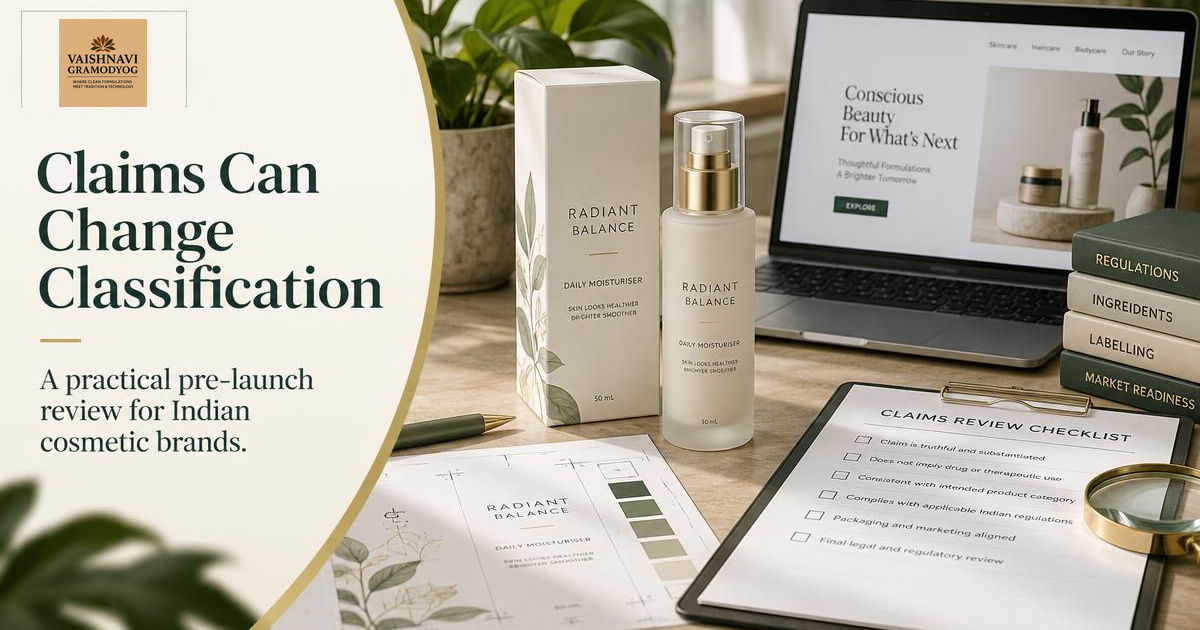
A practical guide to cosmetic claims compliance in India: understand the 26 October 2026 CDSCO action, assess intended use, substantiate claims and align labels with digital listings.
When a Cosmetic Claim Becomes a Drug Claim: Lessons from CDSCO’s 26 October 2026 Action
SEO title: Cosmetic Claims Compliance in India: What the Latest CDSCO Action Means for Brands
Meta description: A practical guide to cosmetic claims compliance in India: understand the 26 October 2026 CDSCO action, assess intended use, substantiate claims and align labels with digital listings.
Primary keyword: cosmetic claims compliance India
Suggested slug: cosmetic-claims-compliance-india-cdsco-classification-2026
Why this matters now
A product may be formulated and registered as a cosmetic, yet the way it is promoted can create a separate regulatory problem. The words used on a label, website, marketplace listing or advertisement shape what consumers understand the product is intended to do.
In a notice dated 26 October 2026, the Central Drugs Standard Control Organisation (CDSCO) cancelled an import registration certificate after finding that the marketed website described a product as a treatment for dissolving fat cells and reducing their size. CDSCO stated that these were drug claims and did not fit the statutory definition of a cosmetic. It also recorded a mismatch between claims on the marketed website and the approved product label. Read the CDSCO notice.
This is a specific enforcement action—not a rule that every strong cosmetic performance claim is automatically a drug claim. Its operational message is important: classification, approved product information and public-facing claims must be reviewed together before launch and whenever marketing copy changes.
1. Start with intended use, not the headline
The Drugs and Cosmetics Act defines a cosmetic around articles applied to the human body for cleansing, beautifying, promoting attractiveness or altering appearance. CDSCO’s cosmetics overview reproduces this definition and outlines the regulatory framework.
That boundary matters. A claim about cleansing, conditioning, moisturising or improving the appearance of skin or hair is different from a promise to treat a disease, alter a physiological process or deliver a medical outcome. The exact wording and the overall impression created by the product name, label, imagery, directions and digital content all matter.
Rule 36 of the Cosmetics Rules, 2020 prohibits a cosmetic from conveying an idea that is false or misleading to the intended user. The official CDSCO Cosmetics Rules page provides the governing rules. Rule 36 is not a substitute for classification review: a claim may raise both a misleading-claim issue and a question about whether the intended use remains within the cosmetic definition.
The first question is not “Can we fit this on the carton?” It is: What will a reasonable consumer understand this product is intended to do?
2. What the 26 October 2026 CDSCO notice signals
The notice concerned an imported product holding an import registration certificate. CDSCO recorded that the website marketed it as treating the user by dissolving fat cells and reducing their size. The authority stated that these were drug claims and did not attract the definition of cosmetics. It also noted differences between the claims on the marketed website and the approved product label.
The order cancelled the product’s import registration certificate from the date of issue. It followed a show-cause notice and an assessment of the response. The notice does not establish that every claim involving body appearance is prohibited; it documents the authority’s findings in that particular case.
Two controls follow:
- Classification control: review whether the product’s stated purpose and claims remain within the cosmetic definition.
- Claims-version control: ensure the label, approved product information and live website or marketplace content do not drift apart.
3. Build a claim-to-evidence matrix before artwork
Every objective claim should have a defined meaning and evidence appropriate to that meaning. Do not start with attractive phrases and search for a report afterwards. Start with the product, its intended use, the formula and the result that can honestly be demonstrated.
| Claim family | Questions to resolve | Typical supporting record |
|---|---|---|
| Composition or “free-from” | Is the statement accurate for the complete formula? | Approved master formula, raw-material specifications and supplier declarations |
| Sensory or appearance | What exactly is described—feel, finish, shine, softness or visible appearance? | Defined evaluation method, trained-panel record or suitable consumer-use assessment |
| Instrumental performance | Which parameter was measured, by what method and at what time point? | Product-specific protocol, raw data, analysis and final report |
| “Dermatologically tested” or similar | Who evaluated the finished product, under what protocol and on which version? | Study protocol, investigator details and signed report, with relevant participant and safety records |
| Comparative or quantified | What is the comparator, sample, duration and calculation? | Study design, comparator rationale, dataset and substantiation report |
| Therapeutic or disease-related | Does the claim imply treatment, cure, prevention or a non-cosmetic physiological action? | Pause and escalate for product-specific classification review |
This is a working framework, not a list of tests legally mandated for every claim. The method must match the wording: a sensory panel cannot establish an instrumental result, and an ingredient brochure alone cannot prove a finished-product outcome. Evidence from one formula version should not automatically be extended to a materially changed version.
The ASCI Code says objectively ascertainable advertising claims should be capable of substantiation. It also applies to written and graphic matter on packaging. ASCI is a self-regulatory body, not a government licensing authority, but its Code is relevant when brands plan packs and campaigns.
4. Keep one approved claim across every channel
Claims can drift when regulatory, e-commerce, influencer and customer-service teams work from separate files.
Create a controlled claim register for each SKU. Record:
- Exact wording, including qualifiers and footnotes.
- Product name, variant, formula code and version.
- Intended use and classification rationale.
- Evidence reference, report date and product version tested.
- Approved channels: pack, website, marketplace, social, catalogue and sales presentation.
- Required qualification or limitation, placed close to the claim where needed.
- Owner, reviewer, approval date and next review trigger.
Use this register as the source of truth. Keep dated proofs of live listings and ads. A disclaimer should clarify a claim, not contradict the headline.
The CCPA Guidelines for Prevention of Misleading Advertisements and Endorsements, 2022 provide an additional consumer-protection framework for advertising and endorsements. Assess the presentation consumers actually see, not just the isolated sentence in a brief.
5. Put a claims gate into the OEM development workflow
Claims review belongs before artwork release.
At product-brief stage: separate desired consumer benefits from proposed advertising language. Flag disease, treatment, physiological or absolute wording early for regulatory assessment.
At formulation stage: map each performance statement to the formula’s design intent and identify whether evidence is ingredient-, formula- or finished-product-level.
At sample approval: freeze the formula version and identify which tests apply to that version. If the formula changes, assess whether the evidence remains relevant.
At artwork approval: compare the product name, front-panel claim, directions, warnings, supporting text and visual cues with the approved claim register.
At digital launch: check the website, marketplace, social creative, influencer brief and sales deck against the approved wording; save dated copies.
After launch: reopen review after a formula, use, test, label, market or campaign change, or when consumer feedback suggests a different interpretation.
6. A practical pre-publication checklist
Before a SKU or campaign goes live, ask:
- Does the stated purpose fit the cosmetic definition?
- Could the product name or headline imply treatment of a disease or a non-cosmetic physiological action?
- Is each objective claim supported by evidence relevant to this finished product?
- Does the evidence match the current formula and variant?
- Are numbers, time periods and comparisons traceable to the report?
- Do the approved label and digital channels communicate the same intended use?
- Are disclaimers consistent with the main claim?
- Has a named person approved the final artwork and digital copy?
- Is the claim register stored with the SKU’s technical and artwork records?
- Has a regulatory specialist reviewed any borderline classification question?
If classification is uncertain, pause the claim for product-specific regulatory assessment. A footnote cannot make a different intended use acceptable.
7. What brand owners should ask their manufacturing partner
During OEM evaluation, ask:
- At what stage are proposed claims reviewed?
- Can the manufacturer link each test report to the formula version tested?
- How are changes to formula, variant or directions communicated?
- Who signs off technical evidence, and who approves final public claims?
- Can the team provide a controlled handover pack for the approved product and artwork?
The manufacturer can support formulation, technical evidence and quality documentation; the brand and its advertising partners remain responsible for the final public claims. Document the split of responsibilities.
FAQs
Can a cosmetic make performance claims in India?
Yes, if they remain consistent with cosmetic intended use and are not misleading. Objective claims need evidence supporting the wording and finished product.
Does a cosmetic registration or manufacturing licence approve all marketing claims?
No. A licence or registration is not blanket approval for later website, marketplace, influencer or advertising claims. The 26 October 2026 CDSCO notice illustrates why marketed claims and approved product information must remain aligned.
Is “clinically tested” automatically acceptable?
No. Define the product version, method, outcome and limitations. Use the wording only when evidence supports the impression it creates.
Can a brand use the same claims on the carton and website?
Consistency is necessary but not sufficient: each claim must be accurate, supported and appropriate for intended use. Digital copy should not make a stronger promise.
What should an OEM do when a client requests a borderline claim?
Record the wording, pause artwork approval, assess intended use and evidence, and refer uncertainty for qualified regulatory review.
Conclusion: treat claims as controlled product information
The CDSCO action dated 26 October 2026 is a reminder that a cosmetic’s regulatory position is not protected by its formula or paperwork alone. The intended use communicated to consumers matters, as does consistency between approved product information and marketing claims.
For brands and manufacturers, the practical answer is a shared claims register, evidence matched to the exact formula and wording, version-controlled artwork, and a digital review before publication. Build that gate into development, and marketing can move faster without asking the product to promise more than its evidence—or its regulatory category—can support.
CTA: Before approving your next private-label skincare, haircare or body-care launch, ask for a joint review of the product brief, proposed claims, formula evidence and final artwork. Explore Vaishnavi Gramodyog’s contract manufacturing capabilities and quality and compliance approach.
This article is general industry information, not a legal opinion or product-classification decision. Obtain qualified regulatory advice for the specific product, formula, intended use and market.
Brief us on your next SKU
Share the product, volume and launch window. We'll respond with a manufacturing plan and documentation scope for your target market.
Request bulk quote