
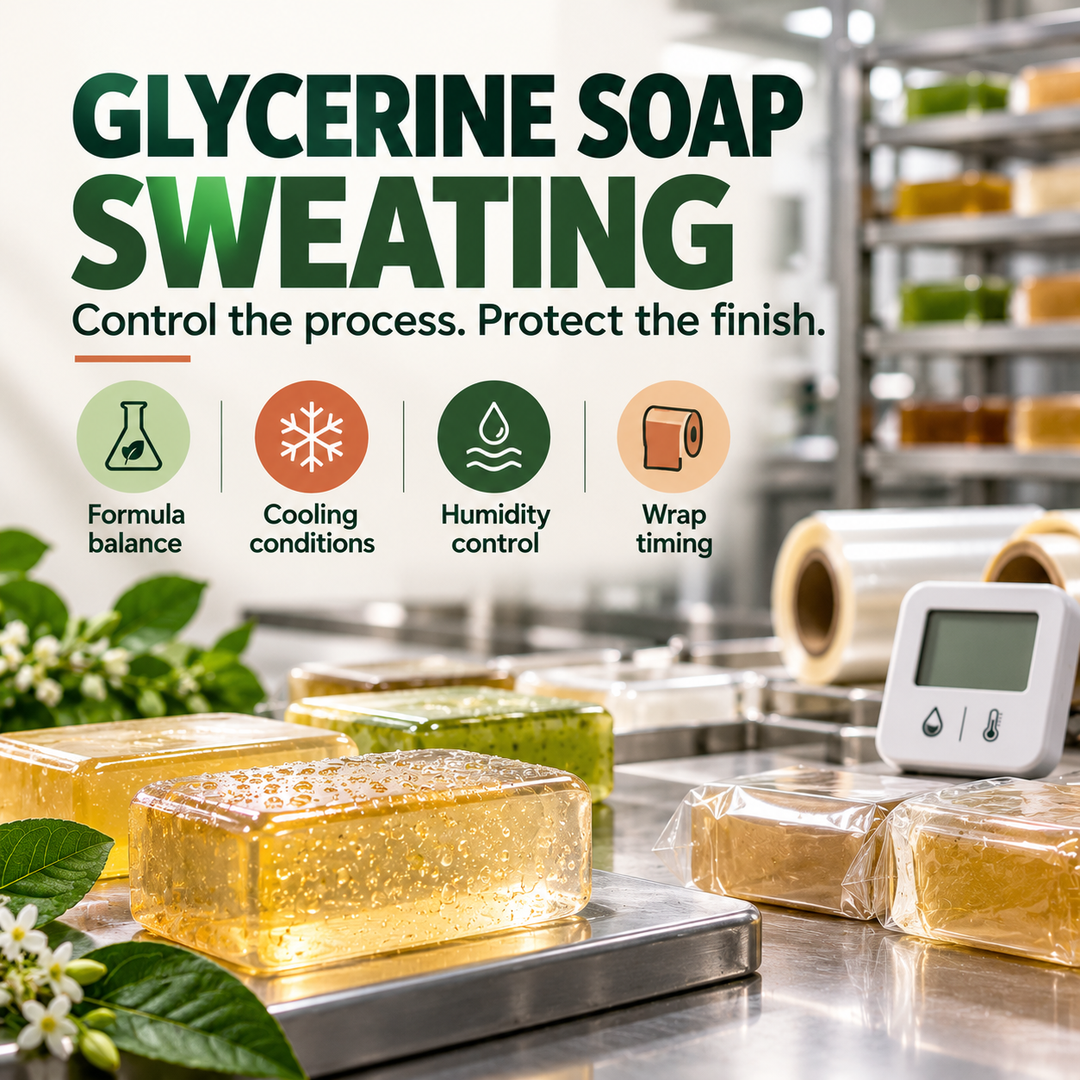
Learn why glycerine soap develops surface moisture and how formulation, cooling, humidity control and wrap timing help protect bar appearance.
Clear glycerine soap is often chosen because its appearance helps sell the product: light passes through the bar, colours and botanicals remain visible, and the finished piece can look clean and premium. But when small droplets appear on the surface, the bar can look wet, sticky or less polished. Labels may loosen, dust may adhere, and the visual standard can become inconsistent between batches.
This surface moisture is commonly called glycerine dew or “sweating.” It is often related to glycerin’s ability to attract and retain moisture, but the practical cause can involve several interacting factors: the formula, room conditions, cooling, handling and the time between demoulding and wrapping. Treating every case as a packaging problem—or changing the formula before checking the process—can waste time and create new quality issues.
For bath-and-body brand quality teams, the useful question is not simply, “How do we stop sweating?” It is, “Which part of our product and process is allowing the surface appearance to change, and how do we prove the corrective action works?”
Why glycerine soap develops surface moisture
Glycerin is a hygroscopic humectant: it interacts with water and can absorb moisture from its surroundings. That property is useful in personal care, but it also helps explain why exposed glycerine-rich bars may develop surface droplets under humid conditions.
A 2022 study published in Scientific Reports examined moisture retention and sorption in glycerin solutions. The researchers observed moisture sorption in the tested solutions above 70% glycerin by weight. This is a finding about those glycerin solutions and test conditions—not a universal glycerine-soap formula limit. A finished bar contains a broader matrix of ingredients, so its response must be evaluated as a complete product.
In practical manufacturing, surface moisture can be influenced by:
- Ambient relative humidity: exposed bars can interact with moist air while cooling, waiting or being handled.
- Temperature changes: moving a cooler bar into warmer, more humid air can create condensation, which may resemble glycerine dew.
- Formula composition: glycerin and other humectants, solvents, water-containing additions and the overall base design affect the finished bar’s moisture behaviour.
- Cooling and handling: demoulding conditions, airflow, surface temperature and the time a bar remains exposed can influence what appears on the surface.
- Packaging timing and protection: a bar left uncovered for too long has more opportunity to interact with the environment before it is protected.
These factors are connected. A formulation that performs acceptably in a controlled room may look different after exposure to a humid warehouse, a cold-to-warm transition or prolonged open storage.
First, distinguish glycerine dew from other defects
Before changing a recipe, inspect the nature of the problem. Fine, clear droplets on an otherwise uniform bar may be consistent with glycerine dew or condensation. But wetness alone does not prove the cause.
Look for other symptoms: separation, unusual colour change, unexpected odour, softening, cracking, deformation, visible contamination or a change in the bar’s normal texture. If the batch shows unexplained changes, isolate it for quality assessment rather than assuming that wiping the surface or wrapping the bars will resolve the issue.
Record when the droplets first appeared. Did they develop immediately after demoulding, after a shift in room conditions, during storage, or after the bars moved between locations? Did all trays show the same behaviour, or only certain positions? Did the issue appear on one production date or across multiple batches?
This simple timeline helps separate a likely environmental or handling issue from a formula-related pattern. It also gives the technical team a more useful starting point than the general observation that “the soap is sweating.”
Four controls to review before reformulating
1. Review the formula as a system
Glycerin is not the only variable. The full base composition, the balance of solvents and humectants, the type and amount of fragrance, colourants, extracts and other additions can affect the finished bar. Water-containing additions deserve particular scrutiny because they may change the moisture balance or local appearance.
Avoid changing several ingredients at once. If the formula is adjusted before the room conditions and wrapping sequence are understood, it becomes difficult to identify which change made the difference. A formulation change should be based on controlled comparison and followed by checks for clarity, hardness, lather, fragrance, appearance and other agreed specifications.
For botanical or decorative variants, evaluate the base and the finished variant separately. A clear base that behaves well on its own may respond differently after additions are introduced. The objective is to preserve the intended appearance and performance without creating new issues elsewhere in the product.
2. Control cooling and exposure time
Document the sequence from pouring to setting, demoulding, surface inspection and wrapping. The goal is a repeatable process—not an arbitrary rule that every bar must be wrapped at the same clock time regardless of its actual condition.
Use consistent handling and allow the bars to reach the approved condition for wrapping. Avoid unnecessary temperature swings during cooling and staging. If the production area has zones with different environmental conditions, record where bars are held and whether the issue is concentrated in a particular location.
The cooling and handling sequence should be part of the batch process record. When a problem appears, this allows the team to compare actual conditions instead of relying on memory.
3. Monitor the room environment
Relative humidity and temperature should be treated as process observations when surface appearance is sensitive to the environment. Record conditions in the relevant production, cooling and packing areas at defined points. A single reading taken at the start of a shift may not represent the conditions experienced by bars later in the day.
Where the facility experiences seasonal humidity swings, compare performance across representative conditions rather than validating only during a dry period. Environmental control may be appropriate, but the correct operating limits should be established through product-specific trials and documented justification—not copied from a generic internet recommendation.
4. Verify the wrapping method
Packaging is the next control to review, not the only one. Check whether the wrap creates a consistent barrier, whether seals are complete, whether the bar is wrapped in the approved condition, and whether handling after wrapping damages the seal. Also check that the chosen packaging does not create an unwanted appearance or interfere with labels and presentation.
A wrapper can protect a well-controlled product from further exposure, but it should not be used to conceal an unexplained defect. If droplets are already present before wrapping, record that observation and investigate it. If the bar looks correct before wrapping but changes later, evaluate the packaging, storage conditions and temperature history together.
A simple investigation protocol for manufacturers
When a sweating complaint occurs, use a structured comparison:
- Define the defect: photograph the bar, describe the droplets or surface change, and record when it was first noticed.
- Identify the affected lots: compare batch numbers, production dates, tray or rack locations, and the timing of demoulding and wrapping.
- Review process records: check formula version, actual additions, cooling sequence, room temperature and relative humidity where recorded.
- Compare storage and transport history: note any cold-to-warm movement, prolonged exposure, damaged wrapping or unusual storage conditions.
- Run a controlled trial: compare a representative sample under documented conditions, changing one factor at a time wherever practical.
- Set acceptance criteria: agree what acceptable surface appearance, clarity, hardness and packaging condition look like before the trial begins.
- Verify the correction: repeat the check under relevant conditions and document the outcome before changing routine production instructions.
A useful trial should answer a decision. It should show whether the existing formula and process can meet the target, whether a specific process adjustment is sufficient, or whether formulation development is needed. That is more valuable than a one-time sample that looks acceptable on the day it is inspected.
What brand quality teams should specify to their manufacturer
A clear brief reduces ambiguity during development and complaint investigation. Include the bar type and weight, transparency target, colour and botanical inclusions, fragrance, intended market and climate exposure, storage expectations, wrapping method, visual acceptance criteria and any known history of surface moisture.
Share photographs of both acceptable and unacceptable samples when possible. State when the problem appears—before packing, after storage, during transit or at the customer’s location. If the product is intended for a humid market or seasonal launch, mention that at the beginning rather than after the first commercial batch.
For glycerine soap projects, explore our glycerine soap manufacturing capabilities and transparent soap information. Final specifications should be confirmed through representative product evaluation and agreed quality checks.
Frequently asked questions
Is glycerine soap sweating always a formulation failure?
No. Surface moisture can be influenced by environmental exposure, temperature transitions, cooling and wrapping as well as formulation. Diagnose the pattern before deciding that the formula must change.
Can wrapping alone prevent sweating?
A suitable, well-sealed barrier can reduce exposure to humid air, but it may not resolve every cause. The bar should be inspected before wrapping, and the wrapping process should be assessed alongside cooling, handling and storage.
Should the same humidity limit be used for every glycerine soap?
Not automatically. The right operating limits depend on the product, process and packaging system. Establish and document product-specific conditions through controlled trials rather than applying a generic number to every formula.
What information helps a manufacturer investigate a complaint?
Provide the batch or lot details, photographs, time to first appearance, storage and transport history, wrapping condition, and any available temperature or humidity records. These details make it easier to identify a repeatable cause.
Protect the finish with evidence, not guesswork
A premium clear bar must keep its intended appearance beyond the production tray. Start by documenting the conditions around the defect, compare the formula and process systematically, and verify the corrective action under relevant storage and handling conditions.
Share your bar format, target climate and current wrap timing to request a humidity-risk review for your next glycerine soap project.
For a manufacturing discussion, use our contact page.
Technical references
Brief us on your next SKU
Share the product, volume and launch window. We'll respond with a manufacturing plan and documentation scope for your target market.
Request bulk quote